 Book now
 What to See at Angkor Wat: A Room-by-Room Guide
The causeway and moat, the bas-relief galleries, the five towers and the steep Bakan climb — what to look for and where to find it.
Most visitors come to Angkor Wat for one photograph — the five towers mirrored in the dawn pool — and leave having seen barely a tenth of the temple. That is a shame, because Angkor Wat is as much a gallery of sculpture as a building. Behind the iconic skyline lies almost a kilometre of carved bas-relief, a moat nearly two hundred metres wide, a sandstone causeway built as a model of the cosmos, and a steep final climb to the central sanctuary that the medieval builders meant to feel like ascending to the kingdom of the gods. This guide walks you through the temple in the order you actually meet it, so you know what you are looking at and where the great things are hidden.
The Moat and the Causeway
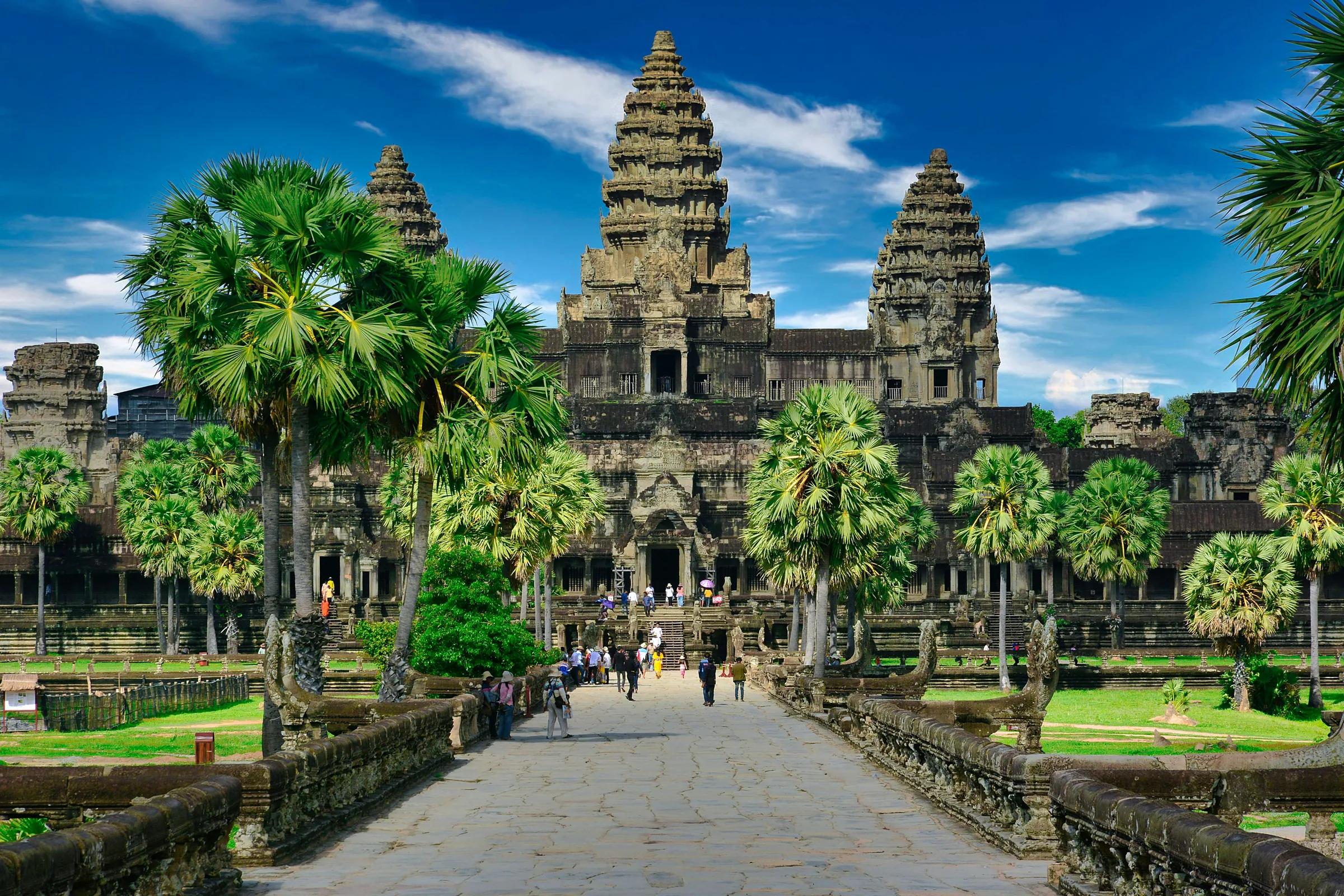
You meet Angkor Wat across water. The temple sits inside a rectangular moat roughly 190 metres wide and more than five kilometres around its perimeter, a vast rectangle of stillness that both defends the sanctuary and stands for the cosmic ocean surrounding the Hindu universe. The main approach is the western sandstone causeway, a raised stone bridge that carries you over the moat and through the outer enclosure wall toward the towers. Walking it slowly is part of the experience: the five towers rise and resolve as you advance, and the long perspective is deliberate theatre on the part of Suryavarman II's architects.
It is on this western causeway, to the left as you face the temple, that the two reflecting pools sit. The northern pool is the classic sunrise viewpoint, where the towers appear doubled in the water as the sky behind them colours. Even outside dawn, the causeway frames the best full-temple views, and the libraries and the two pools break the long walk. Take your time here before plunging into the galleries — the scale of Angkor Wat is best understood from this approach, where moat, wall, causeway and towers line up as a single composition built to mirror the structure of the heavens.
The Bas-Relief Galleries
The outer gallery of the first level carries Angkor Wat's greatest treasure: a near-continuous band of carved bas-relief running around all four sides, among the longest and finest in the world. Each wall tells a story. The most celebrated panel is the Churning of the Sea of Milk on the eastern gallery, in which 88 gods and 92 demons haul on the body of a giant serpent to churn the ocean and release the elixir of immortality, with Vishnu presiding at the centre. It is a masterpiece of rhythm and movement, the tug-of-war frozen in stone across dozens of metres.
The other walls are no less rich. The western gallery shows the Battle of Lanka from the Ramayana, where Rama defeats the demon Ravana, and the northern stretch depicts the Kurukshetra War from the Mahabharata, two armies converging in a chaos of chariots, elephants and infantry. These are not random decorations but a programme: Hindu cosmology and epic, carved so that walking the gallery clockwise is a kind of pilgrimage through the myths. Bring a torch or visit when light rakes across the stone — low morning or late-afternoon sun throws the shallow carving into relief and makes the figures leap from the wall.
The Towers and the Bakan Climb
Angkor Wat is built as a temple-mountain, a stone model of Mount Meru, the mountain at the centre of the Hindu cosmos. Its silhouette is a quincunx — four corner towers around a taller central one — and that central shrine rises to about 65 metres above the ground, crowning three rising rectangular galleries. The arrangement is not decorative but cosmological: the moat is the ocean, the walls the mountains at the world's edge, and the five towers the peaks of Meru itself, home of the gods. Reading the temple this way turns a beautiful skyline into a deliberate map of the universe.
The innermost and highest level is the Bakan, a roughly 60-metre-square sanctuary reached by genuinely steep stairways. The builders made the ascent hard on purpose — the steepness is said to represent the difficulty of reaching the realm of the gods — and modern visitors climb a fixed wooden staircase added for safety. The Bakan enforces the dress code strictly: shoulders and knees must be covered, and it closes on certain Buddhist days, so it is not always open. The reward for the climb is the closest view of the central tower, the carved galleries below, and the green sweep of the surrounding forest from the heart of the monument.
The Libraries, the Apsaras and the Quiet Details
Two small, elegant buildings flank the causeway and cruciform terraces — the so-called libraries, free-standing pavilions that frame the approach and offer some of the best vantage points for photographing the towers without crowds in the foreground. Whether they truly held manuscripts is uncertain, but they are exquisite miniature temples in their own right, often overlooked by visitors marching straight for the central sanctuary. Pausing at the northern library at sunrise is a quieter alternative to the scrum at the reflecting pool.
Look closely at the walls everywhere and you will find Angkor Wat's other population: its carved celestial women. The temple is covered with more than 1,700 figures of devatas and apsaras — divine and dancing women — ranging from tiny decorative figures to near-life-size portraits, each with individual hairstyles, jewellery and expressions. No two are quite alike, and spotting them becomes a game that slows you down in the best way. These details, easy to walk past, are where the human warmth of Angkor Wat lives, and they reward the visitor who treats the temple as a gallery to be read rather than a backdrop to be photographed and left.
Sunrise and the Reflecting Pools
The signature image of Angkor — the five towers mirrored in water against a pink-and-gold sky — happens at the reflecting pools on the western causeway. The northern of the two pools, on your left as you face the temple, is the classic spot, where the towers double cleanly in the still water. Angkor Wat opens early, from around 05:00, for sunrise, and the routine is to arrive in the dark, settle by the pool, and wait for the sky to colour behind the silhouette. It is the most popular moment of the day, so the best places fill 30 to 45 minutes before the sun appears.
Sunrise is glorious but it is also the temple's single busiest hour, with crowds packed along the pool edge. Two things help. First, because the Angkor pass is open-dated, you can choose a morning with a clear forecast rather than gambling on a cloudy dawn that mutes the colour. Second, you do not have to fight for the textbook reflection — many visitors love watching the light come up from a quieter corner of the grounds, then exploring the galleries while the sunrise crowd is still clustered at the water. After dawn, the early hours are among the coolest and most rewarding for seeing the rest of the temple.
Frequently asked
What is the most famous carving at Angkor Wat?
The Churning of the Sea of Milk, on the eastern bas-relief gallery, where 88 gods and 92 demons pull on a giant serpent to churn the ocean under Vishnu's direction. It is one of the longest and finest bas-reliefs in the world.
Can you climb to the top of Angkor Wat?
Yes — the upper Bakan level is reached by a steep fixed staircase. It enforces the dress code strictly (shoulders and knees covered), may close on certain Buddhist days, and is not suitable for those uneasy with very steep steps.
Why does Angkor Wat have five towers?
The five towers form a quincunx representing the peaks of Mount Meru, the mountain at the centre of the Hindu cosmos. The whole temple is a stone model of the universe — moat as ocean, walls as mountains, towers as the home of the gods.
What are the carved women on the walls?
They are devatas and apsaras — divine and dancing celestial women. Angkor Wat has more than 1,700 of them, each carved individually with different hairstyles, jewellery and poses, so no two are exactly alike.
How long should I spend inside Angkor Wat?
Allow at least two to three hours to see the temple properly — the causeway and pools, all four bas-relief galleries, the libraries and the Bakan climb. Rushing it in 45 minutes misses most of what makes it extraordinary.
What is the best spot for the sunrise reflection photo?
The northern of the two reflecting pools on the western causeway, to your left as you face the temple. Arrive 30–45 minutes before sunrise on busy mornings to claim a place at the water's edge.
Is there a dress code inside Angkor Wat?
Yes. Shoulders and knees must be covered for all visitors, and the upper Bakan level enforces this strictly, refusing entry to anyone in vests, short shorts or short skirts. A light scarf or sarong is the easy fix.