 Book now
 The History of Angkor Wat
From Suryavarman II and the Khmer Empire to the Vishnu dedication, the turn to Buddhism, Henri Mouhot and modern conservation.
Angkor Wat was built in a single burst of imperial ambition. In the first half of the 12th century, the Khmer god-king Suryavarman II raised the largest religious monument the world had ever seen — a stone model of the Hindu cosmos, dedicated to Vishnu, at the heart of an empire that dominated mainland Southeast Asia. Over the following centuries it shifted faith, weathered the decline of its empire, was wrapped by forest, drew the wonder of European travellers, and finally became a UNESCO World Heritage Site and the emblem on Cambodia's flag. Understanding that arc — empire, dedication, transformation, rediscovery, conservation — turns the postcard skyline into one of the great stories in the history of architecture.
Suryavarman II and the Khmer Empire
Angkor Wat is the work of King Suryavarman II, who reigned from 1113 to around 1150 and built the temple over roughly those same decades. He ruled at the height of the Khmer Empire, the great power of mainland Southeast Asia from the 9th to the 15th century, whose capital region around Angkor was sustained by a vast network of reservoirs and canals — the barays — that watered one of the largest cities of the pre-industrial world. Wealth on that scale, and an ideology of divine kingship, made a monument of Angkor Wat's ambition possible.
For a Khmer god-king, building a great temple was an act of statecraft as much as devotion. The temple housed the god, legitimised the ruler's authority, and was very likely intended to serve as Suryavarman II's mausoleum — a detail reflected in its unusual western orientation, the direction associated with death in Hindu tradition. The result was not merely large but coherent: a single, unified design executed in sandstone hauled from quarries dozens of kilometres away, raised in a few decades into the supreme achievement of Khmer architecture and the largest religious monument on Earth.
A Temple to Vishnu and a Model of the Cosmos
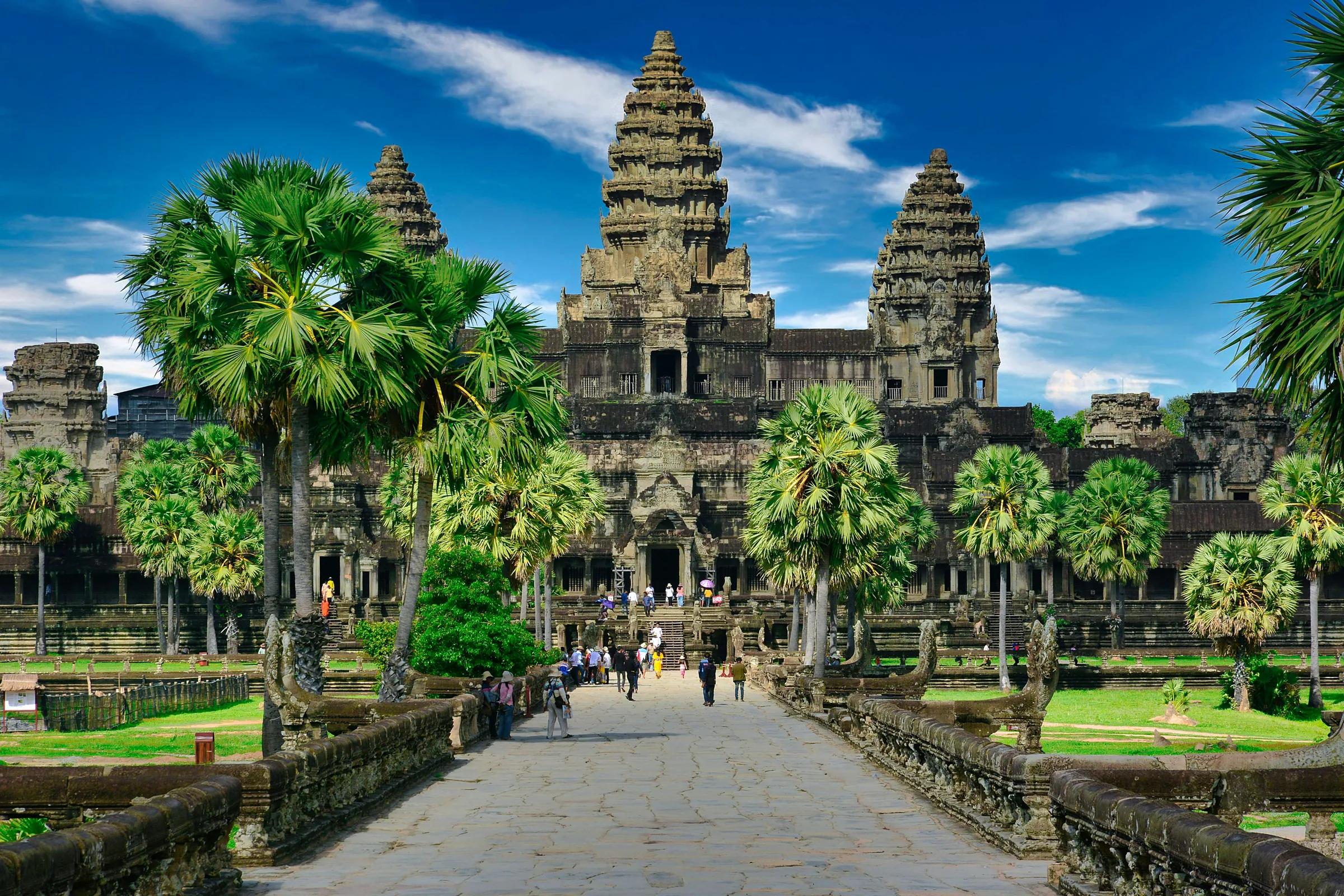
Angkor Wat was conceived as a Hindu temple dedicated to Vishnu, and its whole form is a diagram of the Hindu universe. The temple is a temple-mountain — a stone Mount Meru, the cosmic mountain at the centre of the world, home of the gods. Its quincunx of five towers stands for Meru's peaks; the three rising galleries are the foothills; the enclosing walls are the mountains at the edge of the world; and the broad moat is the cosmic ocean. To move inward and upward through the temple was to journey symbolically toward the divine centre of creation.
This cosmological programme is carried in the carvings as much as the plan. The bas-reliefs of the outer gallery depict the great Hindu epics and the churning of the ocean by gods and demons; the walls teem with apsaras and devatas, the celestial women of the heavens. Every proportion and orientation was charged with meaning. That Angkor Wat reads as both an overwhelming building and a precise religious instrument — a machine for contemplating the order of the cosmos — is the genius of its design, and the reason it has held meaning for worshippers across eight centuries and two religions.
From Hinduism to Buddhism
Angkor Wat did not stay a temple to Vishnu. From the late 13th century onward, as Theravada Buddhism spread through the Khmer world and gradually became the dominant faith of Cambodia, the temple was transformed into a Buddhist site — a change reflected across the Angkor temples, where Hindu imagery was overlaid, adapted or replaced with Buddhist worship. Unlike many of the great temples of the park, Angkor Wat was never wholly abandoned: it remained a place of active Buddhist pilgrimage and devotion through the centuries when the wider city around it was overtaken by forest.
That continuity matters. While Angkor Thom and Ta Prohm fell silent and were swallowed by jungle after the empire's centre shifted south in the 15th century, Angkor Wat stayed in use, tended by Buddhist monks and visited by pilgrims. It is still an active place of worship today, with saffron-robed monks and shrines among the galleries. The temple a modern visitor walks through is therefore a layered object — Hindu in conception, Buddhist in living practice — and its survival as a continuously revered monument, rather than a dead ruin, is a large part of why it endures so vividly.
Rediscovery and the European Imagination
Angkor was never truly 'lost' — Khmer people knew it well, and it remained a Buddhist pilgrimage site — but it entered the European imagination in the 19th century. The French naturalist Henri Mouhot visited around 1860 and his published travel writings brought Angkor Wat to a wide Western audience, famously declaring it grander than anything left by Greece or Rome. His vivid accounts, and the engravings that accompanied them, turned the temple into a sensation in Europe and helped launch the era of French scholarly and archaeological interest in the site.
It is important to set Mouhot's 'discovery' in proportion: he popularised Angkor for the West rather than finding something unknown. But the attention he helped spark had lasting consequences, drawing scholars, surveyors and eventually conservators to the Khmer monuments. Over the following decades the temples were mapped, studied and slowly cleared, and Angkor Wat became both an object of academic study and a symbol of Cambodian identity — so much so that the temple's silhouette was adopted onto the national flag, the only building in the world to feature on a country's flag.
Conservation and World Heritage
Systematic conservation of Angkor began in the early 20th century, led by the École française d'Extrême-Orient, which cleared, studied and stabilised the temples. That work was violently interrupted by Cambodia's years of war and the Khmer Rouge period in the 1970s and 1980s, when conservation stopped and the monuments were left vulnerable. The scale of the threat was such that when UNESCO inscribed Angkor on the World Heritage List in 1992, it simultaneously placed it on the List of World Heritage in Danger.
The decades since have been a conservation success story. The site was removed from the danger list in 2004, and an international effort — with teams from France, Japan, India, Germany and others, coordinated alongside the Cambodian APSARA Authority that has managed the park since the mid-1990s — has stabilised structures, addressed erosion and balanced preservation with the demands of mass tourism. Angkor today is once again among the most visited and revered monuments in the world, a living temple and an archaeological landscape of the first rank, safeguarded for the visitors who walk its galleries each dawn.
Frequently asked
Who built Angkor Wat and when?
King Suryavarman II of the Khmer Empire, who reigned from 1113 to around 1150 and built the temple over roughly those decades, in the first half of the 12th century.
What religion is Angkor Wat?
It was built as a Hindu temple dedicated to Vishnu, then transformed into a Buddhist site from the late 13th century onward. It remains an active place of Buddhist worship today.
Why was Angkor Wat built facing west?
Its unusual western orientation — west being associated with death in Hindu tradition — suggests Angkor Wat was intended partly as a funerary temple, very likely the mausoleum of Suryavarman II, as well as a temple to Vishnu.
Did Henri Mouhot discover Angkor Wat?
Not exactly. Khmer people always knew the site and it remained a Buddhist pilgrimage place. The French naturalist Henri Mouhot popularised it for the West around 1860 with his published travel writings, sparking European interest.
Why is Angkor Wat on the Cambodian flag?
Angkor Wat is the supreme symbol of Khmer civilisation and national identity. Its towered silhouette appears on Cambodia's flag — the only building in the world to feature on a national flag.
When did Angkor become a UNESCO World Heritage Site?
Angkor was inscribed on the UNESCO World Heritage List in 1992 and, given the threats it then faced, simultaneously placed on the List of World Heritage in Danger. It was removed from the danger list in 2004.
Was Angkor Wat ever abandoned?
Unlike many Angkor temples, no. While the wider city was overtaken by forest after the 15th century, Angkor Wat remained a continuously active Buddhist pilgrimage site, which helped preserve it.