 Book now
 Angkor Temples Beyond Angkor Wat
Angkor Thom and the Bayon faces, Ta Prohm's jungle ruins, Banteay Srei, sunset from Bakheng — and how the multi-day pass ties them together.
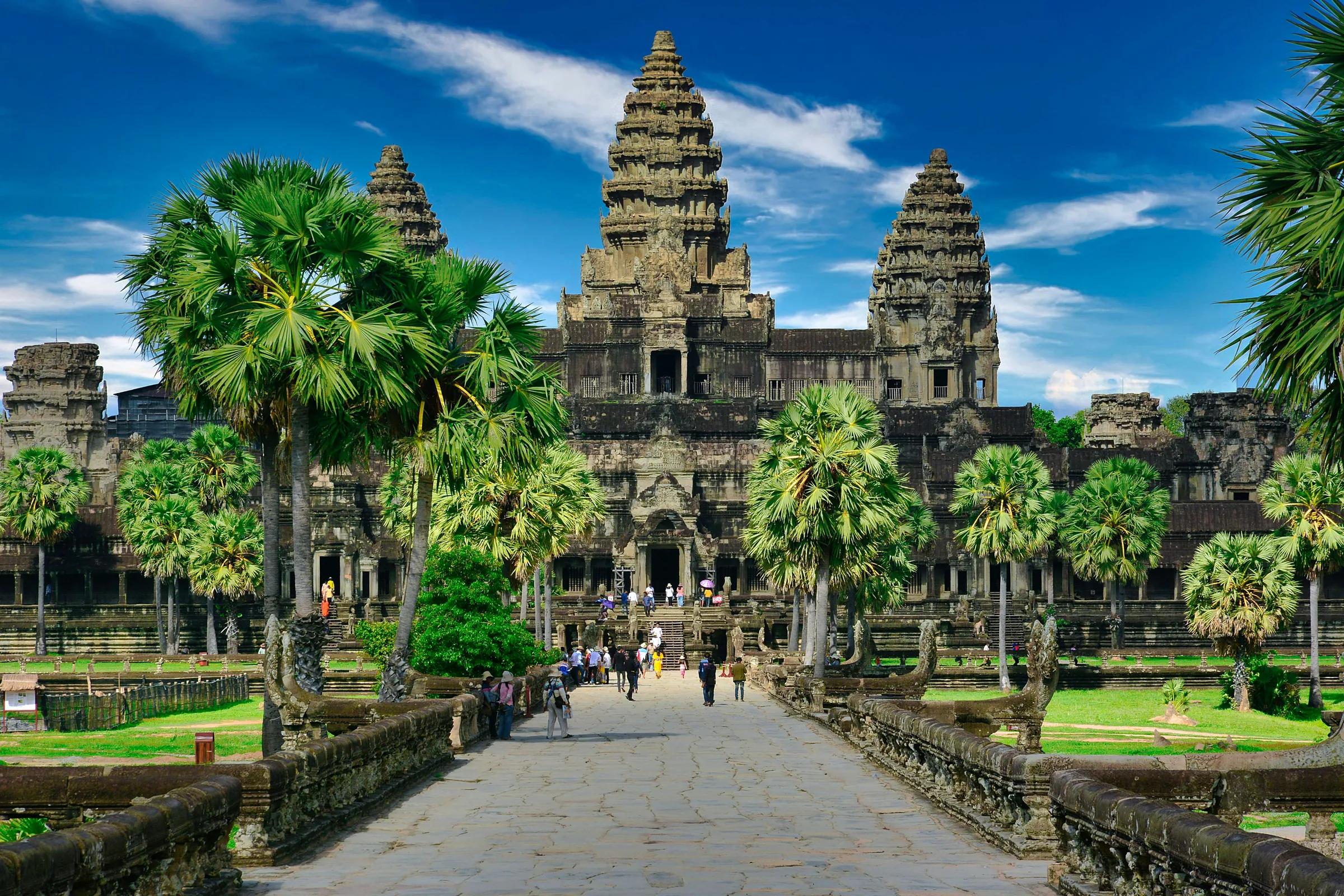
Angkor Wat is the headline, but the wider Angkor Archaeological Park spreads across some 400 square kilometres and holds hundreds of temples built between the 9th and 15th centuries. A single day captures the essential trio; three days or more opens up a landscape of giant smiling faces, jungle-wrapped ruins, rose-pink carving and sunset hills. The park is organised for visitors around two well-trodden loops — the Small Circuit and the Grand Circuit — and a flexible multi-day pass that lets you spread the temples across your stay. This guide covers the temples worth crossing the park for and how the circuits and pass fit them together so you see Angkor as the layered landscape it is, not a single monument.
The Small and Grand Circuits
Visitors navigate Angkor by two classic driving loops, the basis of almost every itinerary. The Small Circuit is the shorter inner loop — roughly 17 kilometres — taking in Angkor Wat, the walled city of Angkor Thom with the Bayon, and Ta Prohm, the essential trio that most people see first. The Grand Circuit is a longer outer loop of around 27 kilometres that adds temples such as Preah Khan, Neak Pean, Ta Som, East Mebon and Pre Rup, with more space and fewer crowds. Your tuk-tuk or car driver will know both routes intimately.
Thinking in circuits is the simplest way to plan. A focused single day usually means the Small Circuit, doing Angkor Wat at sunrise, then the Bayon and Angkor Thom, then Ta Prohm. With more days you add the Grand Circuit and the outlying temples such as Banteay Srei, which sits about 25 kilometres beyond the main group and is usually combined with the Grand Circuit or done as its own half-day. Because the distances are large and the heat fierce, you arrange transport for each loop rather than walking between temples — and an open-date multi-day pass lets you tackle one circuit at a time without rushing.
Angkor Thom and the Bayon
Just north of Angkor Wat lies Angkor Thom, the last great capital of the Khmer Empire, a walled royal city of about nine square kilometres built by King Jayavarman VII in the late 12th and early 13th centuries. You enter through monumental stone gateways topped with serene faces, crossing causeways lined with gods and demons. At its exact centre stands the Bayon, the city's state temple and one of the most extraordinary buildings at Angkor — a dense, baroque mountain of towers utterly unlike the classical clarity of Angkor Wat.
The Bayon is famous for its faces. Its towers carry roughly two hundred huge stone faces, serene and faintly smiling, gazing out in every direction — scholars debate whether they portray Jayavarman VII himself or the compassionate bodhisattva Avalokiteshvara, and probably they are deliberately both. The faces are unforgettable in low morning or late-afternoon light, when shadows deepen their expressions. Don't overlook the Bayon's outer galleries either: their bas-reliefs depict not gods but everyday Khmer life — markets, cockfights, fishing and the great naval battles against the Cham — a rare window onto the ordinary world of the medieval empire.
Ta Prohm, the Jungle Temple
Ta Prohm is the temple where the forest won. Built by Jayavarman VII from 1186 as a Buddhist monastery — originally named Rajavihara, dedicated in honour of his family, with its central image modelled on the king's mother — it was left largely unrestored by the conservators who cleared the rest of Angkor. They chose deliberately to keep it 'in a natural state' as a concession to the romance of the picturesque, and the result is the most atmospheric ruin in the park: corridors and courtyards prised apart and embraced by the roots of giant silk-cotton and strangler-fig trees, stone and timber locked together in slow combat.
It is this marriage of jungle and stone that made Ta Prohm globally famous as a location in the 2001 film Lara Croft: Tomb Raider, earning it the nickname the 'Tomb Raider temple'. That fame means it draws crowds, so timing matters — early morning or later afternoon are calmer than the mid-morning rush. Beyond the famous tree-root photo spots, Ta Prohm rewards slow wandering through its half-collapsed galleries, where light filters green through the canopy and the boundary between ruin and forest dissolves. It is the clearest reminder at Angkor of what time and the jungle do to even the grandest human ambition.
Banteay Srei and the Sunset Hills
About 25 kilometres northeast of the main group stands Banteay Srei, considered by many the jewel of Khmer art. Consecrated in 967, it is older than Angkor Wat and unusual in not having been built by a king — it was the work of a courtier, Yajnavaraha, and dedicated to the Hindu god Shiva. Built from a rose-pink sandstone soft enough to carve like wood, its walls carry the finest and deepest relief carving anywhere at Angkor, dense with mythological scenes and exquisite devata figures. Its name means 'citadel of the women', a nod to that delicate refinement. The extra drive is repaid many times over.
Angkor's sunsets have their own ritual. The classic spot is Phnom Bakheng, a temple-mountain dedicated to Shiva built around 900 by King Yasovarman I on a hill between Angkor Wat and Angkor Thom. From its summit the sun sets over the surrounding forest with Angkor Wat visible in the distance, which makes it hugely popular — visitor numbers to the hilltop are managed to protect the monument, so arrive early to secure a place. Quieter alternatives for evening light include the temple-mountain of Pre Rup on the Grand Circuit, whose warm laterite and brick glow beautifully as the day ends, often with a fraction of the Bakheng crowd.
How the Multi-Day Pass Ties It Together
Seeing the temples beyond Angkor Wat is mostly a question of days, and the Angkor pass is built for it. The 1-day pass covers the essential trio on the Small Circuit. The 3-day pass — the sweet spot for most visitors — can be used on any three days within a 10-day window, and the 7-day pass on any seven days within a one-month window, with no requirement that the days be consecutive. That flexibility is the whole point: you might do the Small Circuit on day one, the Grand Circuit and Banteay Srei on day three, and the outlying jungle temples on day six, resting in between.
All passes are open-dated, so there is no fixed entry time — you simply arrive during opening hours on the days you choose, including for sunrise. One practical detail shapes our booking: the multi-day passes are personal and carry each traveller's photograph, checked at the gates to stop passes being shared, so for 3-day and 7-day bookings we request a simple passport-style photo for each traveller after payment — a quick step we guide you through. With transport arranged loop by loop and the pass spreading your days out, the temples beyond Angkor Wat become an unhurried sequence rather than a forced march in the heat.
Frequently asked
What are the Small Circuit and Grand Circuit at Angkor?
They are the two classic temple-touring loops. The Small Circuit (about 17 km) covers Angkor Wat, Angkor Thom with the Bayon, and Ta Prohm. The Grand Circuit (about 27 km) is a longer outer loop adding Preah Khan, Neak Pean, Ta Som, East Mebon and Pre Rup.
Which temple has the giant stone faces?
The Bayon, at the centre of the walled city of Angkor Thom. Built by Jayavarman VII, its towers carry roughly 200 huge serene faces — thought to depict the king and/or the bodhisattva Avalokiteshvara — gazing out in every direction.
Is Ta Prohm the temple from Tomb Raider?
Yes. Ta Prohm, with its corridors gripped by giant strangler-fig and silk-cotton tree roots, featured in the 2001 film Lara Croft: Tomb Raider and is sometimes called the 'Tomb Raider temple'. It was deliberately left unrestored, entwined with the jungle.
Is Banteay Srei worth the trip?
For most visitors, yes. About 25 km northeast of the main group, this 10th-century temple is carved from rose-pink sandstone in the finest, deepest detail at Angkor and is considered the jewel of Khmer art. It is usually combined with the Grand Circuit.
Where is the best place to watch sunset at Angkor?
Phnom Bakheng, a hilltop temple between Angkor Wat and Angkor Thom, is the classic sunset spot but very crowded with managed visitor numbers, so arrive early. Pre Rup on the Grand Circuit is a quieter alternative with beautiful evening light.
How many days do I need to see the temples beyond Angkor Wat?
One day covers only the essential trio. Three days lets you add the Grand Circuit and Banteay Srei without rushing, and a week opens up the outlying and jungle temples like Preah Khan, Beng Mealea and the Roluos group at a relaxed pace.
Does one pass cover all the Angkor temples?
Yes. A single Angkor pass covers every temple in the main archaeological park — Angkor Wat, Angkor Thom, the Bayon, Ta Prohm, Banteay Srei and the rest — in 1-day, 3-day or 7-day durations. The multi-day passes let you spread your days out.
Do the multi-day passes need a photo?
Yes. The 3-day and 7-day passes are personal and carry each traveller's photo, checked at temple gates. For multi-day bookings we request a simple passport-style photo of each traveller after payment. The 1-day pass does not require this.